If someone spends hours in a wheelchair, especially if they find it hard to move on their own, they need a cushion that spreads the pressure. The international guidelines on preventing pressure ulcers recommend one for everyone at risk when they sit. Choosing between foam, gel, air or a combination depends on the risk, posture, how the person transfers and who will look after the cushion. No cushion, though, replaces changing position and checking the skin every day.
Why the cushion matters: pressure when sitting
When we sit, much of our weight rests on a small area: the sitting bones and the tailbone. If that pressure goes on for a long time without a change, the skin and the tissue beneath it get less blood, and a pressure ulcer (pressure sore) can develop.
- The sitting bones: without a cushion, much of the weight rests on them.
- The tailbone, the other place where pressure builds up.
- A pressure-relief cushion spreads the pressure over a larger area.
According to the NHS, a pressure ulcer can affect anyone, but most often people who have problems moving. The risk is also higher for someone who has had a pressure ulcer before, who is underweight, or who has poor circulation or fragile skin. The international guidelines from EPUAP, NPIAP and PPPIA advise that a person at risk should not sit directly on the seat without a cushion.
If the person also spends a lot of time in bed, see our article “Pressure-relief mattresses: when you need one and how to choose”.
Types of cushion
Wheelchair cushions reduce pressure in two ways: the body sinks in and the cushion moulds around it, or the cushion takes the weight elsewhere to relieve the most loaded spots. Here are the main types.
| Type | How it works | What it needs |
|---|---|---|
| Foam (plain or contoured) | Takes and spreads the weight; contoured foam also helps with a steadier posture | Checking it hasn’t thinned; replacing it once it no longer springs back |
| Gel | The gel moulds under the body and reduces pressure and friction | Checking the gel hasn’t shifted; it is heavier; it can stiffen in the cold |
| Air cells | The body sinks evenly into linked cells | Inflating exactly as the manufacturer’s instructions say, and checking often; it can go down if punctured |
| Combination | A foam base with a gel or air insert | Upkeep according to its parts |
For someone at high risk, or who already has a pressure ulcer, the choice is best made with a doctor, a nurse or a physiotherapist.

Mobility and everyday life
Wheelchairs, walking frames and walking sticks, bath and toilet chairs, pressure-relief mattresses and adjustable care beds.
We will call you to confirm the day and the time.
Or call the nearest shop
How to choose: a checklist
A good cushion suits the person, the wheelchair and daily life at home. Before you choose, answer these questions:
- How many hours a day does the person sit, and can they change position by themselves?
- What is the risk of pressure ulcers? Have they had one before, are they frail, do they have poor circulation or fragile skin?
- Size. The cushion should match the width and depth of the seat, without hanging over the sides or leaving gaps.
- Posture. Does the person sit upright, or slide forward and lean to one side? Contoured cushions help with steadier sitting.
- Transfers. How do they move from the wheelchair to the bed or a chair? A very high or very soft cushion can make this harder.
- The cover. A breathable cover limits heat and moisture; with incontinence, you need a waterproof cover that comes off and can be washed.
- Upkeep. Who will check the inflation or the gel every day? Choose a cushion that you or your relative can look after properly.
The hand check and looking after the cushion
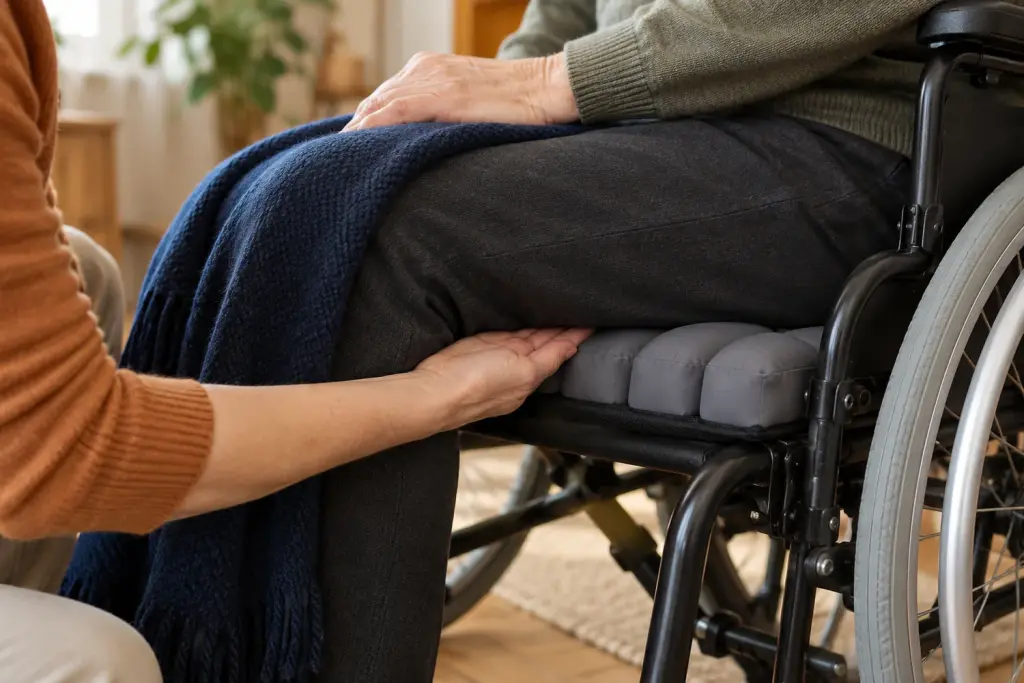
Check the cushion before each use, and check whether it has “bottomed out” while the person is sitting on it. Bottoming out means the body sinks right through the cushion and the sitting bones rest on the base of the seat.
- The hand check. While the person is sitting, slide your hand, palm up, under their sitting bones. If you can feel the base of the seat through the cushion, it is too soft, under-inflated or worn thin.
- Air cushion: inflate it exactly as the manufacturer’s instructions say. Too much air makes the cushion hard; too little lets it bottom out.
- Gel cushion: check the gel hasn’t moved to the sides, and spread it back if the instructions say so.
- Foam: if it has sunk where the person sits and doesn’t spring back, replace it.
- The cover: wash it as the label says. Don’t put folded blankets or several layers of pads on top: they reduce the cushion’s effect.
The guidelines advise that people who use a wheelchair full time learn to check and look after the cushion and its cover themselves. And if something is wrong with the wheelchair itself, Reha Bul has its own repair service that maintains and repairs wheelchairs.
A cushion is not enough: position and skin
A cushion reduces pressure but doesn’t remove it. So three habits matter too.
- Change position often. If the person can, they should shift their weight: lean forward or to one side for a little while. How and how often is best shown by a physiotherapist, according to the person’s strength and ability.
- Limit how long they sit at a time. The international guidelines advise keeping time sitting out of bed as short as possible. For older people who cannot change position by themselves, and after surgery or at the start of rehabilitation, they suggest no more than two hours of sitting at a time to begin with.
- Check the skin every day. Look for patches that don’t fade when pressed, and skin that feels warm, hard or spongy, especially over the sitting bones and the tailbone.
Don’t use ring (“doughnut”) cushions with a hole in the middle. The international guidelines specifically advise against them: they press on the skin around the hole.
When to see a doctor
See your GP if you think you or your relative has a pressure ulcer: for example a patch that doesn’t fade when pressed, or a painful spot on the skin. Get urgent medical help if the skin is hot, swollen or red, there is pus, a high temperature, or the pain is severe or getting worse.
Frequently asked questions
Can we use an ordinary cushion from the sofa?
An ordinary cushion isn’t made to spread pressure, slides on the seat and soon goes flat. Someone at risk of pressure ulcers needs a cushion designed for the job.
Does a ring (“doughnut”) cushion help?
No. The international guidelines advise against ring-shaped cushions, because they press on the skin around the hole.
How long does a cushion last?
It depends on the type and how much it is used. Do the hand check regularly and replace the cushion when it bottoms out, when the foam no longer springs back, or when an air cushion won’t hold its air.
Can we get a cushion with state support?
Some assistive products are provided with state funding under certain conditions. Ask us about the product you need, and see the current steps in our State funding guide.
In the Reha Bul catalogue you will find pressure-relief mattresses and cushions and wheelchairs. Our advisers in our shops in Gabrovo, Stara Zagora and Sevlievo will help you choose a cushion to suit the wheelchair and your relative’s needs.
Sources
Mobility and everyday life
Wheelchairs, walking frames and walking sticks, bath and toilet chairs, pressure-relief mattresses and adjustable care beds.
We will call you to confirm the day and the time.
Or call the nearest shop