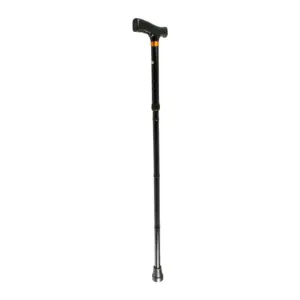
A walking stick only really helps when it is set up for you. The top of the handle should reach the crease of your wrist when you stand up straight with your arm hanging loosely; you hold it in the hand opposite your weaker or painful leg; and you replace the rubber tip at the bottom as soon as its tread wears away or the rubber splits. These three checks take five minutes and make every walk safer.
Picture a stick inherited from someone in the family: a little too tall, with a smooth tip that slides on the tiles. A stick like that can hinder more than it helps. Here is how to check yours.
The right height: the wrist rule
The height is right when the top of the handle is level with the crease of your wrist, and your elbow is slightly bent when you hold the handle. The American Academy of Family Physicians (AAFP) gives an elbow angle of about 15–30°: the arm is relaxed, neither straight nor sharply bent.
- Wear the shoes you usually wear. The height of the sole changes the measurement.
- Stand up straight with your arms hanging loosely by your sides. If you need to, have someone steady you or hold on to a stable piece of furniture.
- Stand the stick upright beside your foot, a little out to the side.
- See where the handle comes to. It should be level with the crease of your wrist.
- Adjust it. On an adjustable stick, press the button, slide the tube to the right hole and check that the button has popped out fully and clicked into place. A wooden stick cannot be adjusted, only shortened, so measure carefully before you cut.
How can you tell the height is wrong? If the stick is too tall, your shoulder hunches up and your elbow is sharply bent. If it is too short, you lean forwards or to one side, which upsets your balance.
- Standing straight with the arm hanging loosely, the top of the handle is level with the crease of the wrist.
- The stick is held in the hand opposite the weaker or painful leg.
- The weaker or painful leg: the stick moves forward together with it.
- Holding the handle, the elbow is slightly bent, about 15–30°: relaxed, neither straight nor sharply bent.
Which hand to hold it in
Hold the stick in the hand opposite your weaker or painful leg. If your left knee hurts, hold the stick in your right hand. That way the stick moves forward together with the weaker leg and takes some of your weight just as you step on it, much like the natural swing of your arms when you walk.
If you use the stick for balance rather than because of one leg, ask your doctor or physiotherapist which hand suits you better. If one side of your body is weak after a stroke, the stick goes in the stronger hand; there is more on this in our article “Home after a stroke”.

Mobility and everyday life
Wheelchairs, walking frames and walking sticks, bath and toilet chairs, pressure-relief mattresses and adjustable care beds.
We will call you to confirm the day and the time.
Or call the nearest shop
How to walk with a stick, and on stairs
When you walk, the stick and your weaker leg move forward together, then your stronger leg steps through. Keep your back upright, without leaning forwards or to the side.
- Keep your steps calm and no longer than usual.
- When you turn, take your time: use small steps and don’t lift the stick high off the floor.
- When you get up from a chair, push up on the armrests, not on the stick; take hold of the stick once you are standing steadily.
For stairs there is an easy rule to remember: up with the good, down with the bad. Hold the handrail with one hand and the stick in the other.
| Direction | First | Then | Last |
|---|---|---|---|
| Up | the stronger leg on the step above | the weaker leg on the same step | the stick |
| Down | the stick on the step below, away from the edge | the weaker leg | the stronger leg on the same step |
The grip: which handle to choose
Choose a handle you can hold comfortably with your whole palm and that doesn’t cause pain. Mayo Clinic advises that if your fingers find it hard to grip, for example with arthritis, a thicker or hand-shaped grip may be more comfortable. Numbness or pain in your palm or fingers is a sign the handle doesn’t suit you.
- T-shaped handle – straight and comfortable for most people; your weight goes down over the shaft.
- Ergonomic handle – wider and shaped to the palm; it spreads the pressure over a larger area.
- Classic crook handle – easy to hang on your arm or the back of a chair, but the grip is narrower.
- Wrist strap – a small detail that stops the stick falling while you unlock the door.
If you need more support, there are also quad sticks with a wide base. All four feet must touch the floor at the same time, or the stick tips over.
The tip: the small part that stops you slipping
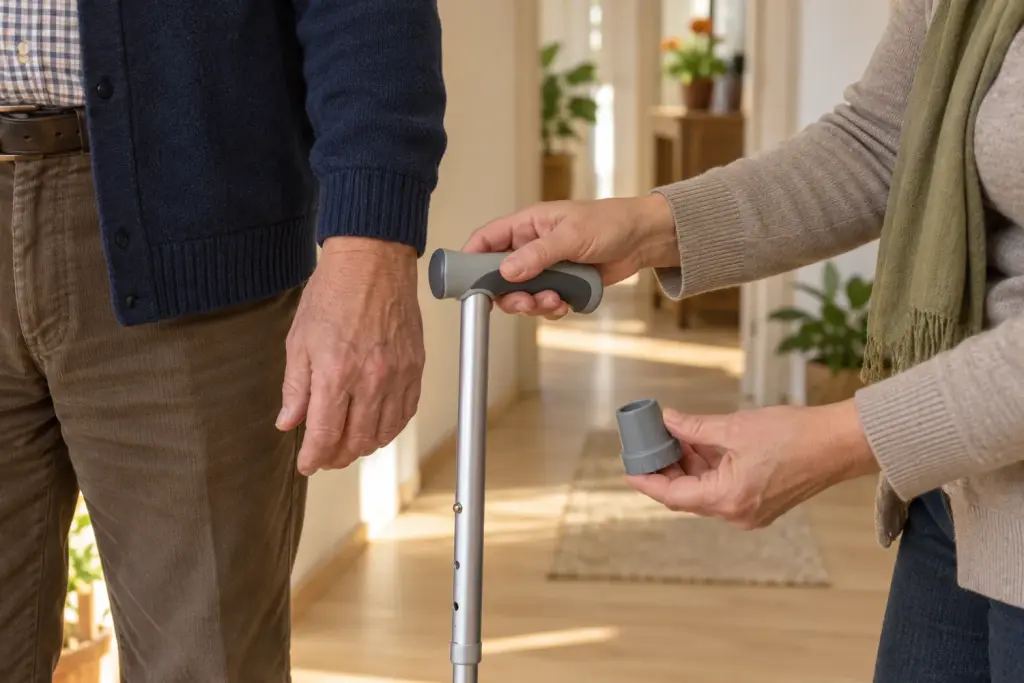
The rubber tip (ferrule) is like the tyre on a car: while it has tread, it grips. Once it is smooth, worn or split, it slips and needs replacing. NHS walking-aid leaflets also advise checking the stick itself: the tube should not be bent or cracked, the holes should be round, the button should click fully into place and the handle should be firmly fixed.
| Part | What to check | When to act |
|---|---|---|
| Tip | Tread on the underside, splits, whether it sits firmly on the tube | Replace it if it is smooth, worn, split or loose |
| Tube | Bends, cracks, dents | Don’t use a stick with a bent or cracked tube |
| Holes and button | Are the holes round, does the button pop out fully | A stretched or oval hole means the stick could slide down |
| Handle | Is it firmly fixed, does it turn | Tighten it or replace the stick |
Spare rubber tips are widely available. Choose one that matches the diameter of the tube and fits snugly. For winter there are also tips with a metal ice spike; we explain how to use them in “A winter without falls”.
When a stick is no longer enough
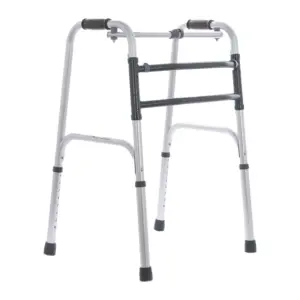
A walking stick is for people who walk fairly steadily and need a little support. If you hold on to the furniture at home, if you have had a fall, or if you are afraid to go out alone, you may need a walking frame or rollator. We explain the differences in “How to choose a walking frame or rollator”. Which aid is safe for you is best judged by a doctor or physiotherapist.
When to see a doctor
- if you have had a fall, even if you weren’t badly hurt;
- if the pain in your leg or back is getting worse despite the stick;
- if you often feel dizzy or increasingly unsteady when you walk;
- if the hand that holds the stick starts to hurt or go numb.
Call 112 straight away if one side of the body suddenly becomes weak, the face droops or speech becomes slurred: this may be a stroke.
Frequently asked questions
Can I use a stick that belonged to someone else?
You can, if it is in good condition and the height is set for you. Check the tube, the button and the tip against the table above. A wooden stick cut for a taller person is usually too long.
How often should I replace the tip?
There is no fixed interval: it depends on how much you walk and on what surfaces. Check it once a month and replace it as soon as the tread wears away or the rubber splits.
Should the stick be made of a light material?
A light aluminium stick is easier to carry and usually adjustable. What matters more than the material is that the height is right, the handle is comfortable and the tip is sound.
Can I get a walking stick with state support?
Some walking aids are provided with state funding under certain conditions. The rules change, so see the current steps in our State funding guide.
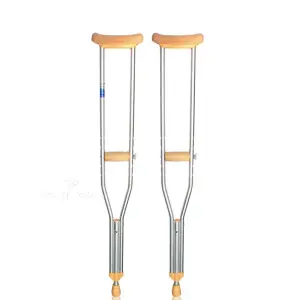
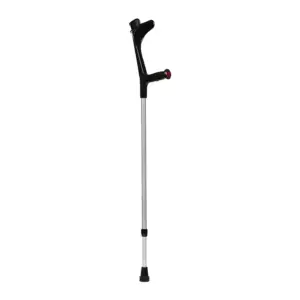
In the Reha Bul catalogue you will find walking sticks, crutches and walking frames. If you are not sure which height or handle is right for you, come to one of our shops in Gabrovo, Stara Zagora and Sevlievo: our advisers will help you choose a walking aid at the right height.
Sources
Mobility and everyday life
Wheelchairs, walking frames and walking sticks, bath and toilet chairs, pressure-relief mattresses and adjustable care beds.
We will call you to confirm the day and the time.
Or call the nearest shop