A baby’s hearing is first checked in the weeks after birth with a short screening test, and after that you follow how the child reacts to sounds and learns to talk. If your child does not respond to sounds or their speech is behind for their age, tell your child’s GP. Hearing tests for children are arranged through a doctor: the GP refers the child to an ENT specialist, who decides which test is needed.
The good news is that a child’s hearing can be tested at any age, even while a baby sleeps. Here is what to know as a parent or grandparent.
Newborn hearing screening
Screening is a short test that shows whether a baby’s hearing needs a more detailed check. The NHS describes it like this: a small soft earpiece is placed in the baby’s ear and gentle clicking sounds are played. It is done while the baby is settled or asleep, it is not uncomfortable and it has no known risks.
- When. The US NIDCD advises screening before the baby leaves the maternity hospital or, if that did not happen, by one month of age. According to the NHS it is usually done before four weeks, and at the latest by three months.
- If the result is not clear. This is a reason to act quickly, not a diagnosis. A second, more detailed test is arranged with a specialist. NIDCD advises having it by two to three months.
- If hearing loss is confirmed. According to NIDCD, support should start as early as possible, and no later than six months.
Ask at the maternity ward whether your baby’s hearing has been screened, and write down the result. If it has not been done, tell your child’s GP.
Screening does not pick up every type of hearing loss, and hearing can also get worse later. NIDCD notes that hearing loss can occur at any time of life, for example after ear infections, some illnesses, a head injury or loud noise. So even after a clear result, keep an eye on how your child hears.
What to watch for at each age
The best test at home is everyday life: how your child responds to your voice and how they learn to talk. NIDCD has put together a checklist of skills by age. Here are the main points:
| Age | What a child usually does |
|---|---|
| Up to 3 months | Reacts to loud sounds, calms down or smiles when spoken to, recognises your voice. |
| 4 to 6 months | Follows sounds with their eyes, notices toys that make sounds, babbles and laughs. |
| 7 to 12 months | Turns towards sounds, listens when spoken to, understands words for familiar things, says one or two words by their first birthday. |
| 1 to 2 years | Points to parts of the body when asked, follows simple requests, puts two words together. |
| 2 to 3 years | Has a word for almost everything, uses two- or three-word phrases, is understood by the family. |
| 3 to 4 years | Hears you calling from another room, listens to the TV at the same volume as everyone else. |
Children develop at different speeds, and some skills arrive towards the end of an age range. NIDCD advises that if your child has not yet reached something on the list, you show the checklist to your child’s doctor and tell them if you think your child has trouble hearing.
Hearing
Hearing tests with audiometry at our licensed centres in Gabrovo and Stara Zagora.
We will call you to confirm the day and the time.
Or call the nearest shop
Signs not to ignore
At any age, trust your instincts: you know your child best. Tell the doctor if you notice that your child:
- does not startle at a loud noise and does not turn when you call;
- speaks loudly or unclearly for their age;
- often says “What?” and asks you to repeat things;
- turns the TV or music up loud;
- struggles to hear from a distance or loses focus when people are talking around them;
- has frequent ear infections.
The NHS describes several of these signs in glue ear: the middle ear fills with fluid and hearing is temporarily reduced. It is much more common in children and usually clears up on its own within about three months. If it lasts longer, the doctor may refer the child for a hearing test.
Where and how a child’s hearing is tested
A child’s hearing test starts with the doctor. Your child’s GP examines the ears and, if needed, refers the child to an ENT specialist (an ear, nose and throat doctor), who decides which test is needed and where it is done.
The tests are matched to the child’s age, so even very young children can be tested. The NHS describes the main ones:
- Newborns: a small earpiece in the ear and gentle clicking sounds while the baby sleeps.
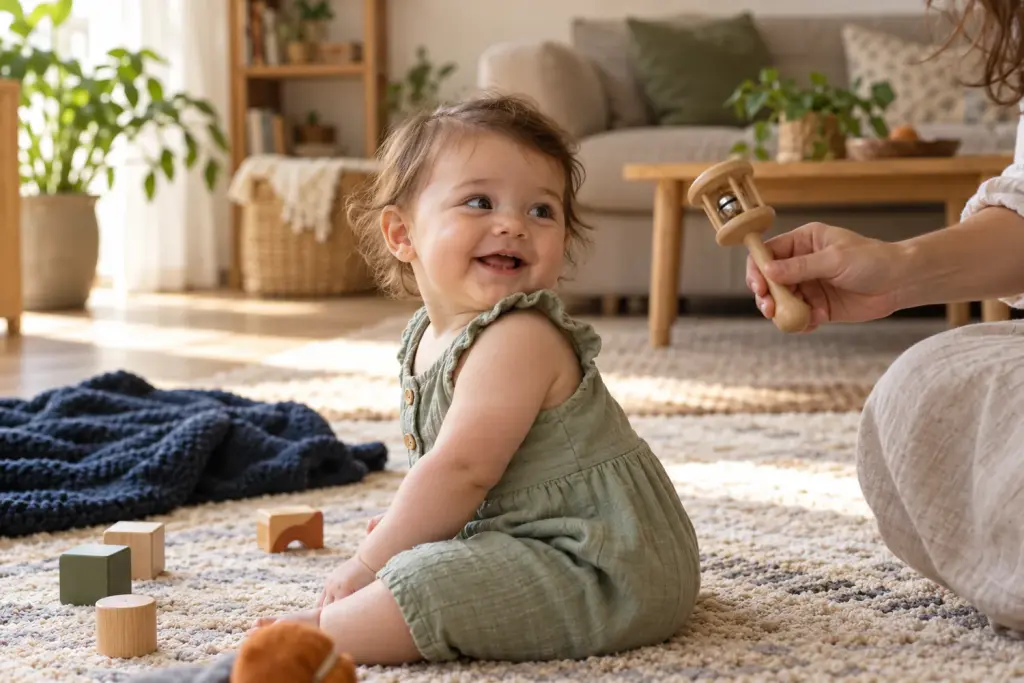
- Babies and toddlers: the child hears a sound and learns to link it to a visual “reward”, such as a toy that lights up and that they turn towards.
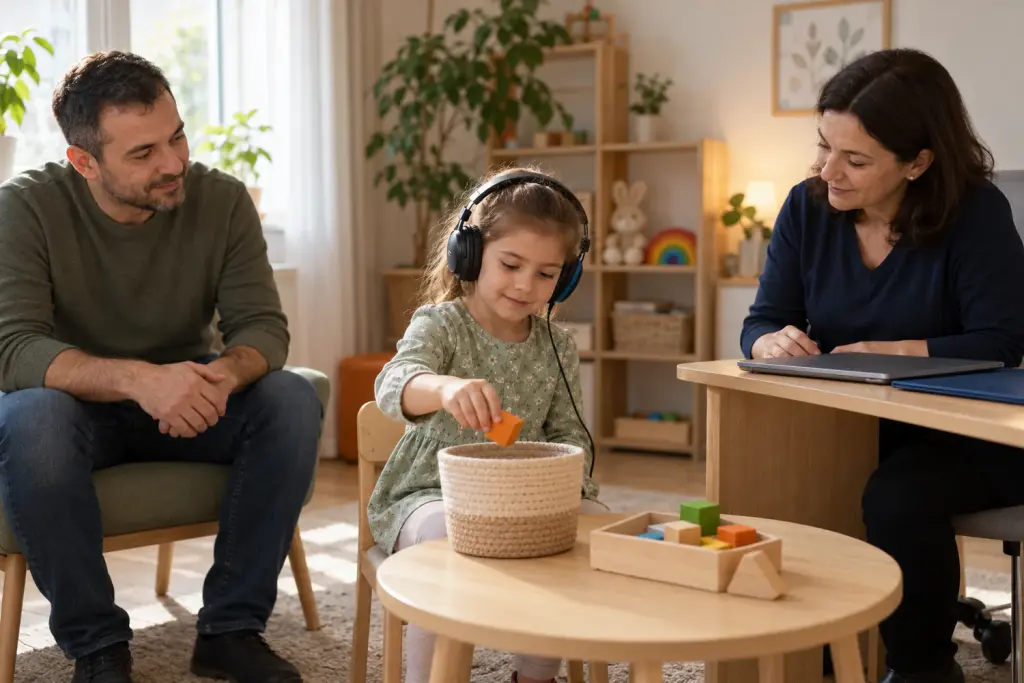
- Pre-school children: play audiometry. The child listens to sounds and does something simple each time, such as dropping a block into a box.
- Older children: the child listens to different sounds through headphones and presses a button each time they hear something.
The tests do not hurt. Prepare your child with a few words, as if for a game: “We’re going to listen to sounds and drop some blocks.”
When to see a doctor
If anything about your child’s hearing or speech worries you, talk to the GP now, without waiting for the next check-up. NIDCD advises speaking to your paediatrician as soon as you have concerns, at any age.
Get urgent medical help, the same day, if your child:
- has suddenly stopped hearing in one or both ears;
- is hearing worse and worse over days or weeks;
- is not hearing well and also has earache or discharge from the ear.
Also tell the doctor if hearing has not come back after treatment for an ear infection or earwax.
Frequently asked questions
Isn’t a baby too young for a hearing test?
No. Newborn screening is done in the first weeks while the baby sleeps, and there is a suitable test for every age.
My two-year-old says very little. Could it be their hearing?
There can be many reasons, but a hearing check is one of the first steps. Show the GP what your child does, using the table above.
Are headphones and loud toys dangerous?
Loud noise can damage hearing at any age. Keep headphone volume moderate, take breaks and choose toys that are not too noisy.
Can hearing that drops during an ear infection stay low?
With glue ear, hearing usually recovers within about three months. If it does not, the doctor will refer the child for a test.
Hearing in the family and Reha Bul
A child’s hearing test starts with the GP and the ENT specialist. If your child is prescribed a hearing aid, our guide Help from the state explains how to get a medical device with state support. And if a grandparent’s hearing is fading, at our hearing centres in Gabrovo and Stara Zagora we test hearing with an audiometer and explain the results. We describe how the test works for adults in How to check your hearing, and for calm conversations in the family see How to talk with someone close to you who does not hear well. For an adult’s hearing test, you can book an appointment online.
Sources
- Newborn hearing test — NHS
- Hearing tests for children — NHS
- Your Baby’s Hearing Screening and Next Steps — NIDCD, National Institutes of Health
- Your Baby’s Hearing and Communicative Development Checklist — NIDCD, National Institutes of Health
- Glue ear — NHS
- Deafness and hearing loss — World Health Organization
Hearing
Hearing tests with audiometry at our licensed centres in Gabrovo and Stara Zagora.
We will call you to confirm the day and the time.
Or call the nearest shop